

Sleep: Nature’s Most Powerful Longevity & Performance Aid
We live in a culture that often celebrates productivity, busy schedules and burning the candle at both ends. Sleep is frequently treated as something we can sacrifice when life gets busy, or simply catch up on at the weekend.
But what if we’re underestimating its importance?
Sleep is one of the most powerful, yet frequently overlooked, foundations of human health. It is during sleep that the body undertakes essential processes involved in cellular repair, immune regulation, metabolic health, memory consolidation, emotional processing and neurological recovery.
The implications of poor sleep extend well beyond how refreshed we feel in the morning.
Research published in the journal SLEEP examined 1.38 million people across 16 prospective studies and found that habitual short sleep was associated with a 12% higher risk of all-cause mortality compared with the reference sleep duration.
More recently, a large UK Biobank study involving almost 61,000 participants found that people with more regular sleep-wake patterns had a 20–48% lower risk of all-cause mortality compared with those with the least regular patterns.
These are observational findings, not proof that poor sleep directly shortens life. However, they highlight just how closely our sleep habits are associated with our long-term health and survival.
The message is simple:
Sleep deserves the same, if not more, attention and respect as nutrition, exercise and the other foundations of our health.
The good news is that improving sleep doesn’t necessarily require complicated routines, expensive supplements or sophisticated technology. Often, the most effective changes start with the simple things we do every day.
Five simple ways to start improving your sleep
1. Establish a consistent sleep-wake routine
Perhaps the most important place to start. Aim to go to bed and wake up at roughly the same time every day, including weekends. Consistency helps regulate your circadian rhythm – your body’s internal 24-hour biological clock.
2. Get outside and seek natural morning light
Expose yourself to natural daylight as early as possible after waking. Morning light helps synchronise your internal body clock, supports daytime alertness and helps regulate the timing of melatonin release later in the evening. A morning outdoor walk is an excellent place to start.
3. Protect your sleep opportunity
Give yourself enough time to sleep. Most adults need at least 7–9 hours, although individual requirements vary. Work backwards from your intended wake-up time to establish a realistic bedtime. Don’t routinely sacrifice sleep to fit more into your day.
4. Be mindful of caffeine, alcohol and evening stimulation
Avoid caffeine in the afternoon and evening, Although alcohol may initially make you feel sleepy, it can disrupt sleep quality and cause more fragmented sleep. Also, begin reducing bright overhead light, and the light from screens as bedtime approaches.
5. Create an environment that encourages sleep
Keep your bedroom dark, quiet, comfortable and cool. Establish a simple wind-down routine during the final 30–60 minutes before bed. Dim the lights, put away your devices, read, and cool your core body temperature with a hot shower, sauna or bath. Give your nervous system an opportunity to transition from alertness to rest.
Model The Behaviours You Would Like Others To Embrace
Although our children may be experiencing physiological changes that naturally delay their desire to sleep, we can still encourage the simple behaviours that will promote good quality sleep.
1. Prioritise morning daylight
Encourage your teenager to get outside soon after waking. Natural morning light helps synchronise their circadian rhythm, supports daytime alertness and helps establish the timing of their sleep-wake cycle. Even a short outdoor walk or breakfast outside can help.
2. Establish a consistent wake-up time
Encourage a reasonably consistent wake-up time throughout the week, including weekends. Large variations in sleep and wake times can shift their body clock later, making Monday mornings particularly difficult. Try to avoid weekend lie-ins that extend several hours beyond their usual routine.
3. Create an evening light and technology curfew
Encourage teenagers to put away phones, computers and gaming devices at least 60 minutes before bedtime. Dim household lighting in the evening and create a calmer environment. Remember, it’s not just screen time that matters; bright evening light can also interfere with the natural timing of melatonin release.
4. Make winding down a family habit
Rather than simply instructing teenagers to go to bed earlier, help them establish a routine that encourages relaxation. Reading, a warm shower, gentle stretching, listening to calming music or journaling can help them transition away from the stimulation of the day.
Don’t just tell your teenager to go to bed earlier. Help them prepare their biology for sleep.
Perhaps the most important thing is to recognise that teenagers aren’t simply smaller adults. Their brains and bodies are undergoing significant biological changes, and their sleep patterns reflect this.
Choose one or two habits, practise them consistently and observe how you feel.
Click on the links below to access your FREE sleep resources:
How to Hack Your Smartphone, PC & Laptop For Better Sleep
Why Light Is Just As Important As Food
Your Circadian Clock
RB Health- Sleep BetterGuide
RB Health- Better Sleep Action Plan
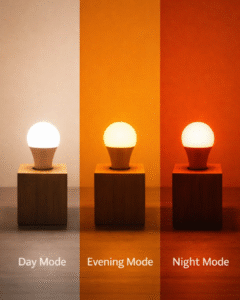
To receive a 10% on your Sleep Better bulbs, click on the link below:
MY SLEEP BETTER BULB

To purchase high quality amber tinted blue blocking glasses, click on the link below:
MY COOL BLUE BLOCKING GLASSES
(contact me for 10% discount)
FINAL THOUGHT
Our role as parents isn’t to enforce better habits, but to help our kids understand their biology and develop the awareness and skills to protect and take responsibility for their own health. We can do this more effectively by being a role model with our own habits and behaviours.
In the wise words of Aristotle:
“The purpose of knowledge is action, not knowledge.”
Sleep Well,