
The Catharsis of Cleaning Out the Closet
It’s often said that the truth shall set you free, and as part of Men’s Mental Health Awareness Month, I wanted to add more personal context to my last blog about the mismatch between performance and alignment, which can also be described as the disconnect between the roles we are playing in life and the true self that is often quietly screaming for air.
Large parts of my life, like many men out there, have been a shining example of this misalignment between who we really are and who we think we should be.
I have spent years trying to figure life out for myself, and getting lost in the performance of trying to fit into societies template of a successful man. Years of seeking validation and acceptance before actually experiencing and embodying a better understanding of what really cultivates inner peace and fulfilment.
This blog was challenging to write and share, but also very cathartic. It’s a summary of some of my greatest struggles taken from a book I am currently writing about ‘thriving in a modern world’. I’m well aware that putting something like this out into the world may open me up to judgement, but I have no fear because being judgemental is just part of human nature.
I hope this blog encourages other men to write, speak and share their inner struggles because we’re typically not so great at being vulnerable and sharing our burdens. More so than ever before, we know that….
Vulnerability is not weakness, it’s strength without the performance.
The Performance of Masculinity
For most of my teen and early adult life, I believed being a man meant being physically, mentally and emotionally tough. Less sensitive, less vulnerable, more respected, and more validated. So I tried to earn my worth through toughness and external approval. However beneath the bluff of a strong exterior was a young boy who just wanted safety, acceptance and belonging.
I grew up without a strong male role model to guide me. I was fostered before the age of one and have never known who my biological father is or was. Apparently I was removed from the care of my biological mother for my own safety and don’t remember ever feeling close to my foster parents. From very early on in life, I was in survival mode- both at home and at school.
Growing up as brown kid in a white working class remote part of East Yorkshire was a constant struggle for acceptance. There were regular fights and constant bullying at school. I still remember my older sister fist fighting with older boys to protect me. Nobody taught me how to stand up for myself, navigate conflict, or express the rage and anger that burned inside of me.
As a young boy I didn’t know who I was, where I was from, and why I was so different. If I could sum up my life in 3 words from the age of around 9-16 it would be angry, scared and insecure. Looking back to my early childhood years, I had been expressing signs of what I define as ‘deep stress’ through eczema, asthma, sleep paralysis and bedwetting.
The body really does keep the score!
The lack of safety I felt created a deep distrust of people and a disconnection from myself, so I tried to create my own safety by becoming physically tough.
Becoming the Tough Guy
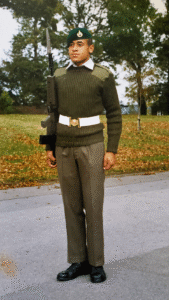
At the age of 14 I started lifting weights and my body responded well. At the age of 17, I joined the HM Royal Marine Commandos.
I went for the Royal Marines because it’s regarded as one of the most elite military corps in the world, and I wanted to be seen as a tough guy. I was also desperate to escape my home environment, and I was already drifting towards the wrong crowd. As brutal as it was at times, it is probably the best thing I have ever done because it rewired me physically, mentally and emotionally.
For the first time in my life I felt respected, I felt important and I felt proud. The uniform, the training, and the reputation gave me identity, belonging, accountability and purpose. There was no room for victimhood or a bad attitude. It was do or die, and very early in training something arose inside me that refused to be broken. The intensity and difficulty of Royal Marine training reveals who you really are.
I still experienced racism in the corps. One of my fondest memories is of my drill instructor Corporal Capon telling me that i should be swinging in the trees, not marching on the drill square. I was also told on a few occasions that because I stood out, I would have to try harder than everyone else to succeed.
My time in the RM Commandos also introduced me to boxing, which terrified me at first. I had spent most of my life being scared of weakness, being defeated and exposed, only to eventually find out that getting punched in the face was not as catastrophic as my imagination had convinced me.
Funny how the things we fear most often become the things that free us.
Boxing gave me composure, confidence and an outlet for the rage that had been buried inside me since childhood. Aggression is part of masculine biology whether modern culture likes it or not. Suppress it and it leaks out sideways through addiction, resentment, poor health and damaged relationships. Learn to channel it and it can become motivation, courage, leadership, and protection.
Military life and boxing allowed me to release and express a part of myself that I had feared for years.
When Identity Collapses
Within 2 years a nagging injury ended my military career. It felt like my entire identity collapsed overnight. I found myself back in Hull, with an old leg injury, and sleeping on my sister’s sofa, trying to figure out what to do. This was the first time I experienced depression. I didn’t know what it was at the time but I didn’t want to face the world, I felt physically and mentally tired. I felt ashamed, weak, disconnected from myself, and the world. The worst part about it was that I couldn’t understand or explain it.
My identity and ego had been built around being a physically capable fighting machine. Being an injured civilian completely compromised that identity, leaving room for old childhood insecurities to resurface.
Because I had no choice but to surrender physically to the pain and weakness that still lingered , I mentally interpreted this as weakness, and a lack of ability to adapt to life as a civilian. In retrospect my body needed the surrender but I took a psychological hit for it.
As much as I tried to fit into life in Hull, I struggled to find direction. I worked cash in hand as a chef in a dodgy Italian, Indian and English restaurant. Oddly enough, I loved the creativity of cooking and still do. But at the time it felt like survival, not purpose.
I gravitated towards society’s misfits because I felt safest around people who also carried anger, frustration and distrust of the world. Some of those relationships took me far too close to the wrong side of the law and, through what I can only describe as divine intervention, I was given an opportunity to course correct.
Success Without Fulfilment
Eventually I received some money from the Royal Marines Charity and used it to train as a Personal Trainer and Sports Therapist. The journey I had been through to recover from my longstanding leg injury made me the best trainer that I never had. The new knowledge i gained helped me rebuild my body and my confidence, and within a year of finishing my training I had moved to London where I was fortunate enough to be chosen as one of the trainers to launch the uk’s most exclusive gym at the time. I was training celebrities, athletes and high-profile clients on a near daily basis.
Just like the military, this new role fuelled my ego, I wanted to be the best trainer on the floor and train the most famous clients. Externally, life looked successful. Good money, great perks and great opportunities. A textbook version of modern masculine success. I was a celebrity trainer by day and also DJing in some of the best London nightclubs by night.
Internally there was still a void. I was substituting fulfilment with stimulation, and self-worth with validation. The highs were temporary and the crashes were becoming heavier. After 10 years of personal training I felt that my work lacked meaning, and that I was not evolving. Towards the end of this period that spiritual void reached breaking point and triggered another heavy bout of depression.
On paper it made no sense.
I had opportunity, income and freedom, yet I became anxious, exhausted and emotionally numb. I would cancel clients, stay indoors and hide from the world, because I felt ashamed that I was struggling despite appearing successful.
The Fear of Responsibility
“You can’t connect the dots looking forward; you can only connect them looking backward.”
Steve Jobs
Looking back at what triggered my breakdown (and subsequent breakthrough) after 10 years as a personal trainer was the realisation that I had to strip away the façade of who I was performing as, and reveal the mess that was underneath. I knew I had outgrown the mask I was wearing, but had no clue of what I wanted on the other side.
I went through a lot of soul searching, resistance and fear to finally come to terms with something that I’d been afraid of since leaving high school- Academia. When I left high school, university was a foreign language in our house. I just wanted to get away from home and earn some money, so doing more studying didn’t make any sense, or even register in my thought process.
I didn’t realise how frightened I was of higher education, and the lack of confidence I had to even write an essay, never mind complete a Degree and a Masters. 5 years later, after a mountain of self-doubt, I had a combined degree and masters in Osteopathy and Naturopathy, one of the most demanding allied healthcare programmes in the UK.
I can’t tell you how many times I thought of dropping out or deferring. Just to add to the intensity, during my 3rd year of study, my partner at the time, and now wife, gave birth to our daughter, and in my final year, we got married.
In the space of 2 years I had completed a Masters, become a Father and got Married- Three things that had scared the life out of me for most of my adult life. Not because they were things that I never wanted, but because the thought of that level of responsibility mortified me, and the little boy inside who had spent years avoiding commitment due to feelings of worthlessness.
Finding Alignment
Becoming an Osteopath introduced me to a far wider and holistic understanding of human health and the myriad inputs that can deplete it. The deep dive into naturopathy during my masters degree helped me see how I’d perpetuated my own suffering through the years, and how our past conditioning, our beliefs, mindset and perspective on life can influence the trajectory of our physical and mental health. We learnt about the biopsychosocial model of health which explained something I had intuitively felt for years.
the different facets of our health can’t be separated into neat little compartments. Our physical health, emotional wellbeing, self-perception, environment and relationships all interact continuously to either strengthen or deplete our wellness.
Our body, mind and environment are constantly communicating with each other.
When I enrolled into Osteopathy, I didn’t fully understand why I was doing it. I just knew I needed some structure and greater alignment with my professional life. I wanted skills that reflected my values instead of feeding my ego. A vocation not just an occupation.
Within months of graduating, we moved to a small island in the English channel called Guernsey where life became slower, simpler and felt more aligned. Working in a close-knit team, treating patients holistically, living by the sea and building a stable family life grounded me in ways that external success never had.
After 3 years of island life, we felt another pull towards growth and eventually moved to Qatar at the end of 2019. I didn’t realise how much the community of Guernsey meant to me until we left, and it hit hard. It felt like we were sacrificing alignment for the allure of money, but it was also a massive adventure that was going to open us up to more of the world.
Everything was going well, then 2020 arrived. For many, including myself, life descended into chaos. Lockdowns hit, clinics closed and healthcare became transactional. I was expected to treat patients online, which for an Osteopath, felt equivalent to being a swimming instructor without water! Numbers now mattered more than health, and I was expected to earn my salary through online appointments.
This arrangement was doomed from the off, and as much as I enjoyed aspects of the lockdown, It was stressful being in a foreign country, employed with no income, and unable to really do much about it. This was when a good friend introduced me to Stoicism.
Stoicism, Surrender and Stillness
Some of the most powerful words I needed to hear in 2020, came from the Roman Emperor Marcus Aurelius, and Epictetus, a stoic philosopher born into slavery.
“You have power over your mind, not outside events. Realize this, and you will find strength.”
Marcus Aurelius
“It’s not things that upset us, but our judgements about things.”
Epictetus
These stoic maxims helped me through the pandemic madness because they reminded me to stop focusing on what was out of my control, and invest my energy in the things that I actually had influence over, such as my thoughts and responses to what was going on. I found it very difficult to have open-minded discourse about the pandemic with most people, and this frustrated the hell out of me. Let’s just say that my choices and opinions weren’t in line with the mainstream narrative, and thanks to Stoicism I was able to be more steadfast in my personal choices.
Since moving to Kuala Lumpur in 2021, life has been far from a bed of roses, and the last five years have tested my alignment more than any other period of my life. Moving between the UK, Dubai and Malaysia, has been a constant wrestling match with uncertainty, ego and responsibility.
I experienced the ego and prestige of training superheroes for Marvel productions, and at the same time, the emptiness of being away from my family for many months at a time. In the end, I prioritised being with my family here in Malaysia, despite not being able to legally work for a significant period of time.
This experience has both humbled and aligned me more deeply. It was psychologically confronting going from working with high-profile clients on blockbuster movies, to being completely anonymous in an unfamiliar country and culture.
It forced me to face some difficult questions:
Who am I without the status, the income, and the external markers of success?
For a long time, these questions created a lot of anxiety, but over time something changed. Instead of trying to force life, I began surrendering to it with more faith, more gratitude and more trust in the belief that what is meant for me will not pass me by.
The Modern Male Crisis
One of the greatest challenges men face is that we rarely stop moving long enough to confront ourselves. We distract ourselves with work, ambition, dopamine, performance, alcohol, status, social media, stimulation and endless optimisation because stillness can feel confronting.
There’s a saying that:
“All of humanity’s problems stem from man’s inability to sit quietly alone in an empty room.”
Blaise Pascal
I think there’s profound truth in that. Because the moment the noise disappears, we are often forced to meet the parts of ourselves we have spent years trying to outrun.
That confrontation is often where real growth happens. Not through performance, and not through distraction. Through the uncomfortable process of sitting honestly with ourselves long enough to recognise what actually matters.
For me, surrender did not mean becoming passive or soft. If anything, it demanded greater discipline and self-awareness than constantly chasing external validation ever did.
I still have daily battles with my ego, pride, self-doubt and the deeply ingrained masculine instincts to provide, protect, perform and prove myself. These feelings and instincts may never fully stop but I have a few habits that help me stay grounded and grateful.
Intense exercise helps me feel physically and mentally capable. It puts life’s challenges into perspective, and is my natural mood enhancer.
I treat food as medicine first because of its undeniable power to either enhance or deplete our physical and mental energy.
I pray daily because conversing with God gives me clarity, gratitude, resilience and sense of hope.
And just as importantly, my work is a passion and an extension of what I stand for:
‘Mens sana en corpore sano’
A healthy mind in a healthy body.
One of my strongest convictions is that if we simply attend to the foundations of our wellbeing, we have the best chance of thriving both physically and mentally in a modern world that is constantly trying to distract, misdirect and deplete us. When we feel physically strong and healthy, we feel mentally stronger and healthier.
Alignment Over Performance
What I have realised in my half century on this planet is that genuine masculinity is not about dominance, emotional suppression or endless performance. It’s about alignment.
Alignment between the person we perform as, and the person we really are.
Modern culture encourages men to constantly optimise. More money, status, followers, productivity and dopamine. Yet many of us are quietly exhausted because we’ve built lives that may look successful externally, but feel empty internally.
The truth is that no amount of performance can compensate for misalignment, and at some point, the body, mind or soul pulls the handbrake. This has happened to me several times.
Now, as I slowly establish myself again professionally in Malaysia, I have far less certainty about the future than I once thought I needed, but for the first time in my life, I feel grounded in some things deeper than performance.
Family, Values, Faith, Integrity, and a genuine desire to help people live better lives.
I do not currently possess many of modern culture’s material symbols of success, but I have something I value far more. I have greater control over myself and how I respond to life.
Perhaps that’s what masculinity really is.
Not the absence of fear, emotion or vulnerability, but the willingness to face life honestly, carry responsibility with courage and remain aligned with our values despite uncertainty.
Because in the end, the strongest men are not the ones who never struggle.
They are the ones willing to truly confront themselves.
In Health